 Booth Design
Leybold Optics Beijing
Leybold Optics develops advanced machinery and materials for producing
optical coatings. Its technologies support packaging, precision lenses,
eyewear, LED displays, and specialized applications for institutional and
government clients. Because many of these products are highly technical or
nearly invisible, the central design challenge was to translate complex
engineering into an engaging physical experience.
I began the exhibition project by identifying three communication priorities:
the company’s history and capabilities, its visual identity, and its products.
My early concepts established this foundation but did not yet express the
precision and sophistication of the brand. The layouts felt rigid, the materials
appeared too simple, and the use of color sometimes distracted from the
information. The booths also needed a better balance between open visitor
areas and private spaces for sales meetings.
To strengthen my understanding of exhibition design, I attended several
trade shows and studied how visitors moved through the spaces, interacted
with displays, and communicated with company representatives. I then
traveled to Germany to learn more about Leybold Optics’ corporate culture
and design philosophy. This experience helped me recognize four important
principles: continuous innovation, purposeful simplicity, flexible assembly,
and original design that supports future growth.
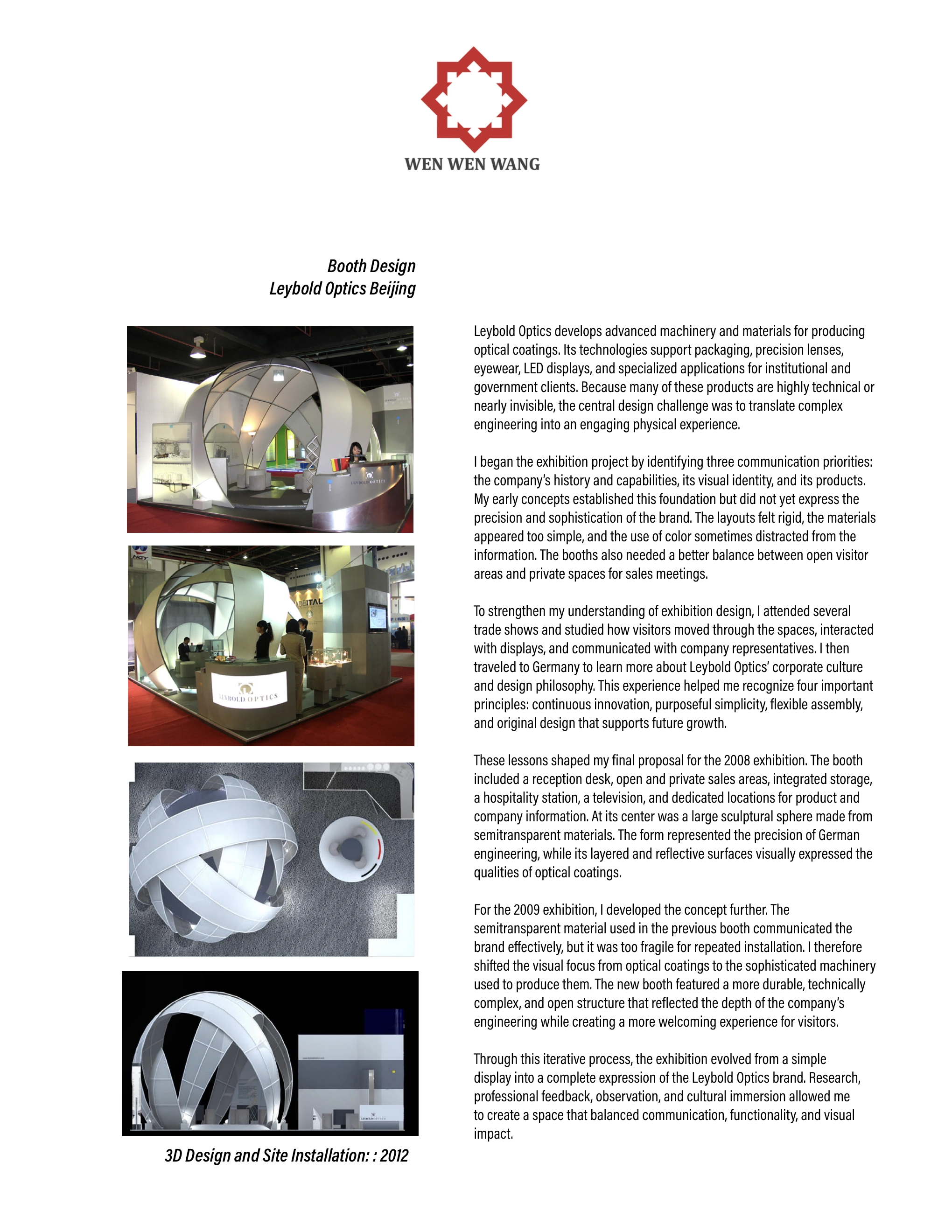
These lessons shaped my final proposal for the 2008 exhibition. The booth
included a reception desk, open and private sales areas, integrated storage,
a hospitality station, a television, and dedicated locations for product and
company information. At its center was a large sculptural sphere made from
semitransparent materials. The form represented the precision of German
engineering, while its layered and reflective surfaces visually expressed the
qualities of optical coatings.
For the 2009 exhibition, I developed the concept further. The
semitransparent material used in the previous booth communicated the
brand effectively, but it was too fragile for repeated installation. I therefore
shifted the visual focus from optical coatings to the sophisticated machinery
used to produce them. The new booth featured a more durable, technically
complex, and open structure that reflected the depth of the company’s
engineering while creating a more welcoming experience for visitors.
Through this iterative process, the exhibition evolved from a simple
display into a complete expression of the Leybold Optics brand. Research,
professional feedback, observation, and cultural immersion allowed me
to create a space that balanced communication, functionality, and visual
impact.
3D Design and Site Installation:: 2012
Booth Design
Leybold Optics Beijing
Leybold Optics develops advanced machinery and materials for producing
optical coatings. Its technologies support packaging, precision lenses,
eyewear, LED displays, and specialized applications for institutional and
government clients. Because many of these products are highly technical or
nearly invisible, the central design challenge was to translate complex
engineering into an engaging physical experience.
I began the exhibition project by identifying three communication priorities:
the company’s history and capabilities, its visual identity, and its products.
My early concepts established this foundation but did not yet express the
precision and sophistication of the brand. The layouts felt rigid, the materials
appeared too simple, and the use of color sometimes distracted from the
information. The booths also needed a better balance between open visitor
areas and private spaces for sales meetings.
To strengthen my understanding of exhibition design, I attended several
trade shows and studied how visitors moved through the spaces, interacted
with displays, and communicated with company representatives. I then
traveled to Germany to learn more about Leybold Optics’ corporate culture
and design philosophy. This experience helped me recognize four important
principles: continuous innovation, purposeful simplicity, flexible assembly,
and original design that supports future growth.
These lessons shaped my final proposal for the 2008 exhibition. The booth
included a reception desk, open and private sales areas, integrated storage,
a hospitality station, a television, and dedicated locations for product and
company information. At its center was a large sculptural sphere made from
semitransparent materials. The form represented the precision of German
engineering, while its layered and reflective surfaces visually expressed the
qualities of optical coatings.
For the 2009 exhibition, I developed the concept further. The
semitransparent material used in the previous booth communicated the
brand effectively, but it was too fragile for repeated installation. I therefore
shifted the visual focus from optical coatings to the sophisticated machinery
used to produce them. The new booth featured a more durable, technically
complex, and open structure that reflected the depth of the company’s
engineering while creating a more welcoming experience for visitors.
Through this iterative process, the exhibition evolved from a simple
display into a complete expression of the Leybold Optics brand. Research,
professional feedback, observation, and cultural immersion allowed me
to create a space that balanced communication, functionality, and visual
impact.
3D Design and Site Installation:: 2012
Booth Design
Leybold Optics Beijing
Leybold Optics develops advanced machinery and materials for producing
optical coatings. Its technologies support packaging, precision lenses,
eyewear, LED displays, and specialized applications for institutional and
government clients. Because many of these products are highly technical or
nearly invisible, the central design challenge was to translate complex
engineering into an engaging physical experience.
I began the exhibition project by identifying three communication priorities:
the company’s history and capabilities, its visual identity, and its products.
My early concepts established this foundation but did not yet express the
precision and sophistication of the brand. The layouts felt rigid, the materials
appeared too simple, and the use of color sometimes distracted from the
information. The booths also needed a better balance between open visitor
areas and private spaces for sales meetings.
To strengthen my understanding of exhibition design, I attended several
trade shows and studied how visitors moved through the spaces, interacted
with displays, and communicated with company representatives. I then
traveled to Germany to learn more about Leybold Optics’ corporate culture
and design philosophy. This experience helped me recognize four important
principles: continuous innovation, purposeful simplicity, flexible assembly,
and original design that supports future growth.
These lessons shaped my final proposal for the 2008 exhibition. The booth
included a reception desk, open and private sales areas, integrated storage,
a hospitality station, a television, and dedicated locations for product and
company information. At its center was a large sculptural sphere made from
semitransparent materials. The form represented the precision of German
engineering, while its layered and reflective surfaces visually expressed the
qualities of optical coatings.
For the 2009 exhibition, I developed the concept further. The
semitransparent material used in the previous booth communicated the
brand effectively, but it was too fragile for repeated installation. I therefore
shifted the visual focus from optical coatings to the sophisticated machinery
used to produce them. The new booth featured a more durable, technically
complex, and open structure that reflected the depth of the company’s
engineering while creating a more welcoming experience for visitors.
Through this iterative process, the exhibition evolved from a simple
display into a complete expression of the Leybold Optics brand. Research,
professional feedback, observation, and cultural immersion allowed me
to create a space that balanced communication, functionality, and visual
impact.
3D Design and Site Installation:: 2012
Booth Design
Leybold Optics Beijing
Leybold Optics develops advanced machinery and materials for producing
optical coatings. Its technologies support packaging, precision lenses,
eyewear, LED displays, and specialized applications for institutional and
government clients. Because many of these products are highly technical or
nearly invisible, the central design challenge was to translate complex
engineering into an engaging physical experience.
I began the exhibition project by identifying three communication priorities:
the company’s history and capabilities, its visual identity, and its products.
My early concepts established this foundation but did not yet express the
precision and sophistication of the brand. The layouts felt rigid, the materials
appeared too simple, and the use of color sometimes distracted from the
information. The booths also needed a better balance between open visitor
areas and private spaces for sales meetings.
To strengthen my understanding of exhibition design, I attended several
trade shows and studied how visitors moved through the spaces, interacted
with displays, and communicated with company representatives. I then
traveled to Germany to learn more about Leybold Optics’ corporate culture
and design philosophy. This experience helped me recognize four important
principles: continuous innovation, purposeful simplicity, flexible assembly,
and original design that supports future growth.
These lessons shaped my final proposal for the 2008 exhibition. The booth
included a reception desk, open and private sales areas, integrated storage,
a hospitality station, a television, and dedicated locations for product and
company information. At its center was a large sculptural sphere made from
semitransparent materials. The form represented the precision of German
engineering, while its layered and reflective surfaces visually expressed the
qualities of optical coatings.
For the 2009 exhibition, I developed the concept further. The
semitransparent material used in the previous booth communicated the
brand effectively, but it was too fragile for repeated installation. I therefore
shifted the visual focus from optical coatings to the sophisticated machinery
used to produce them. The new booth featured a more durable, technically
complex, and open structure that reflected the depth of the company’s
engineering while creating a more welcoming experience for visitors.
Through this iterative process, the exhibition evolved from a simple
display into a complete expression of the Leybold Optics brand. Research,
professional feedback, observation, and cultural immersion allowed me
to create a space that balanced communication, functionality, and visual
impact.
3D Design and Site Installation:: 2012