 The Power of Words
Generation of DA ZI BAO
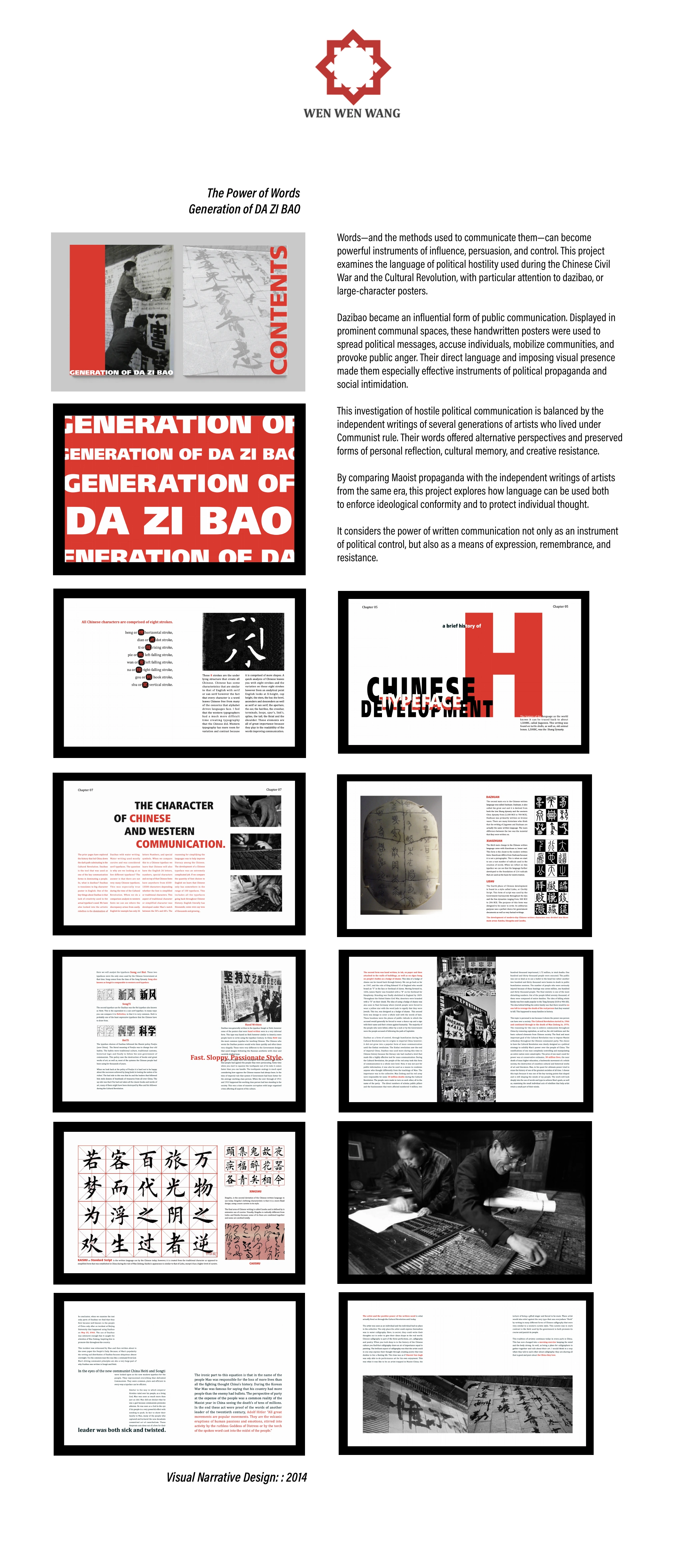
Words—and the methods used to communicate them—can become
powerful instruments of influence, persuasion, and control. This project
examines the language of political hostility used during the Chinese Civil
War and the Cultural Revolution, with particular attention to dazibao, or
large-character posters.
Dazibao became an influential form of public communication. Displayed in
prominent communal spaces, these handwritten posters were used to
spread political messages, accuse individuals, mobilize communities, and
provoke public anger. Their direct language and imposing visual presence
made them especially effective instruments of political propaganda and
social intimidation.
This investigation of hostile political communication is balanced by the
independent writings of several generations of artists who lived under
Communist rule. Their words offered alternative perspectives and preserved
forms of personal reflection, cultural memory, and creative resistance.
By comparing Maoist propaganda with the independent writings of artists
from the same era, this project explores how language can be used both
to enforce ideological conformity and to protect individual thought.
It considers the power of written communication not only as an instrument
of political control, but also as a means of expression, remembrance, and
resistance.
Visual Narrative Design:: 2014
The Power of Words
Generation of DA ZI BAO
Words—and the methods used to communicate them—can become
powerful instruments of influence, persuasion, and control. This project
examines the language of political hostility used during the Chinese Civil
War and the Cultural Revolution, with particular attention to dazibao, or
large-character posters.
Dazibao became an influential form of public communication. Displayed in
prominent communal spaces, these handwritten posters were used to
spread political messages, accuse individuals, mobilize communities, and
provoke public anger. Their direct language and imposing visual presence
made them especially effective instruments of political propaganda and
social intimidation.
This investigation of hostile political communication is balanced by the
independent writings of several generations of artists who lived under
Communist rule. Their words offered alternative perspectives and preserved
forms of personal reflection, cultural memory, and creative resistance.
By comparing Maoist propaganda with the independent writings of artists
from the same era, this project explores how language can be used both
to enforce ideological conformity and to protect individual thought.
It considers the power of written communication not only as an instrument
of political control, but also as a means of expression, remembrance, and
resistance.
Visual Narrative Design:: 2014
The Power of Words
Generation of DA ZI BAO
Words—and the methods used to communicate them—can become
powerful instruments of influence, persuasion, and control. This project
examines the language of political hostility used during the Chinese Civil
War and the Cultural Revolution, with particular attention to dazibao, or
large-character posters.
Dazibao became an influential form of public communication. Displayed in
prominent communal spaces, these handwritten posters were used to
spread political messages, accuse individuals, mobilize communities, and
provoke public anger. Their direct language and imposing visual presence
made them especially effective instruments of political propaganda and
social intimidation.
This investigation of hostile political communication is balanced by the
independent writings of several generations of artists who lived under
Communist rule. Their words offered alternative perspectives and preserved
forms of personal reflection, cultural memory, and creative resistance.
By comparing Maoist propaganda with the independent writings of artists
from the same era, this project explores how language can be used both
to enforce ideological conformity and to protect individual thought.
It considers the power of written communication not only as an instrument
of political control, but also as a means of expression, remembrance, and
resistance.
Visual Narrative Design:: 2014
The Power of Words
Generation of DA ZI BAO
Words—and the methods used to communicate them—can become
powerful instruments of influence, persuasion, and control. This project
examines the language of political hostility used during the Chinese Civil
War and the Cultural Revolution, with particular attention to dazibao, or
large-character posters.
Dazibao became an influential form of public communication. Displayed in
prominent communal spaces, these handwritten posters were used to
spread political messages, accuse individuals, mobilize communities, and
provoke public anger. Their direct language and imposing visual presence
made them especially effective instruments of political propaganda and
social intimidation.
This investigation of hostile political communication is balanced by the
independent writings of several generations of artists who lived under
Communist rule. Their words offered alternative perspectives and preserved
forms of personal reflection, cultural memory, and creative resistance.
By comparing Maoist propaganda with the independent writings of artists
from the same era, this project explores how language can be used both
to enforce ideological conformity and to protect individual thought.
It considers the power of written communication not only as an instrument
of political control, but also as a means of expression, remembrance, and
resistance.
Visual Narrative Design:: 2014