 Rethinking Graphic Design Education
The graphic design industry is undergoing a major transformation. In the past, the
profession evolved at a relatively measured pace, with new tools gradually expanding
a practice largely centered on print. Today, designers must respond to emerging
technologies, digital platforms, and new methods of content creation at an unprecedented
speed.
This rapid change represents a paradigm shift. Designers are no longer expected to work
within a single medium or discipline. They must be prepared to collaborate across fields,
communicate through multiple platforms, and continually adapt to new tools and ways of
thinking. As the profession changes, graphic design education must evolve with it.
My curriculum-development process began with readings from New Contexts/New
Practices: Six Perspectives on Design Education, including Jon Kolko’s “Remapping the
Curriculum” and Peter Hall and Alice Twemlow’s “Fudge It and Nudge It.” These essays
helped me examine the changing conditions of professional design practice and consider
how a more responsive curriculum could encourage greater student engagement.
I expanded my research by studying sixteen lectures from an AIGA conference on design
education, totaling nearly seven hours of material accompanied by presentation slides. I
also consulted books such as Louis Menand’s The Marketplace of Ideas and Writing in the
Margins: Learning to Think in a Design Curriculum. Together, these sources provided
historical context for the development of higher education in the United States and
encouraged me to think critically about the structure, purpose, and future of design
education.
This research led to the development of Effective Design Curriculum, a proposal intended to
help graphic design students build strong foundational skills while discovering and
expanding their individual interests.
The proposed curriculum is organized into four principal areas:
Fundamental design proficiencies
Interdisciplinary learning
Advanced design studies
Preparatory courses for international students
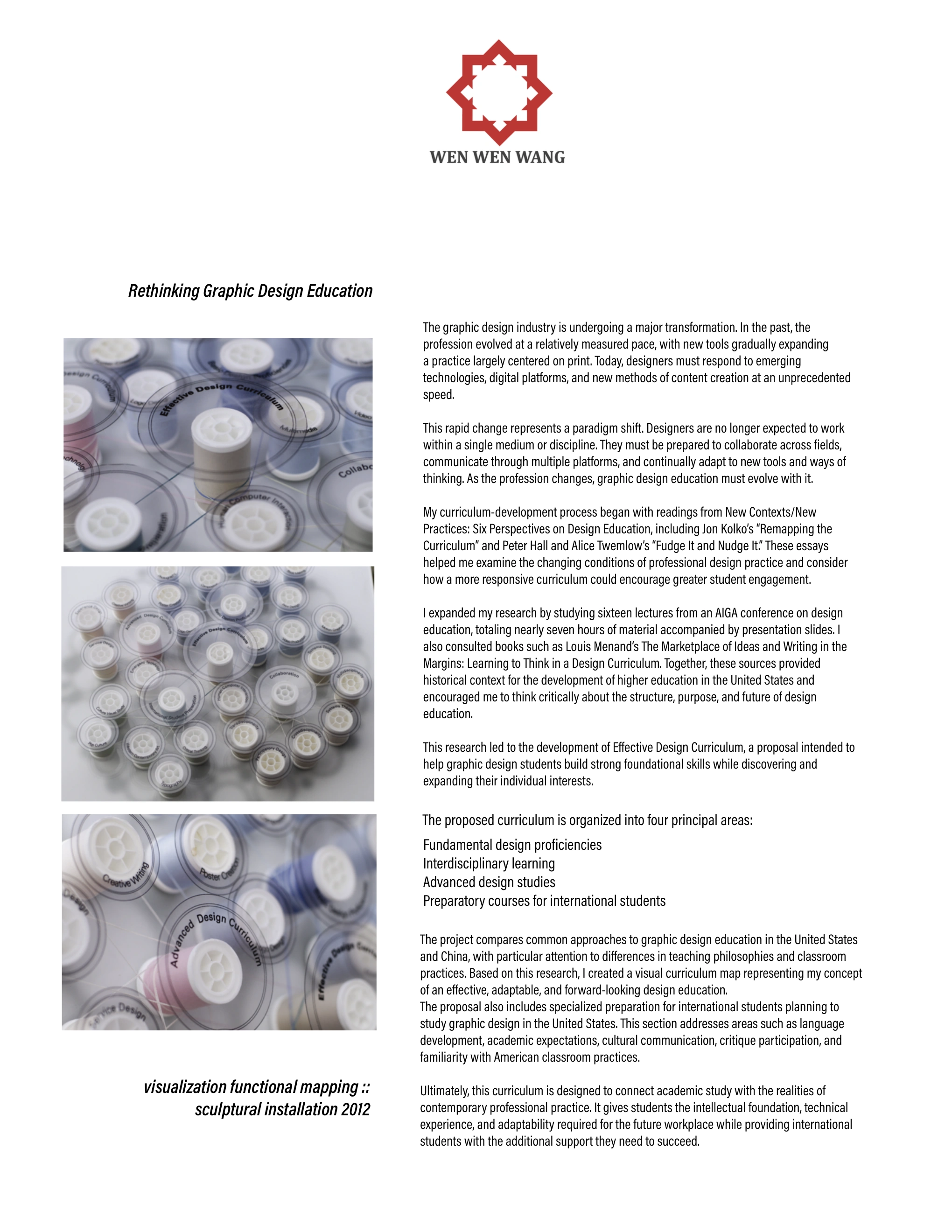
The project compares common approaches to graphic design education in the United States
and China, with particular attention to differences in teaching philosophies and classroom
practices. Based on this research, I created a visual curriculum map representing my concept
of an effective, adaptable, and forward-looking design education.
The proposal also includes specialized preparation for international students planning to
study graphic design in the United States. This section addresses areas such as language
development, academic expectations, cultural communication, critique participation, and
familiarity with American classroom practices.
visualization functional mapping::
sculptural installation 2012
Ultimately, this curriculum is designed to connect academic study with the realities of
contemporary professional practice. It gives students the intellectual foundation, technical
experience, and adaptability required for the future workplace while providing international
students with the additional support they need to succeed.
Rethinking Graphic Design Education
The graphic design industry is undergoing a major transformation. In the past, the
profession evolved at a relatively measured pace, with new tools gradually expanding
a practice largely centered on print. Today, designers must respond to emerging
technologies, digital platforms, and new methods of content creation at an unprecedented
speed.
This rapid change represents a paradigm shift. Designers are no longer expected to work
within a single medium or discipline. They must be prepared to collaborate across fields,
communicate through multiple platforms, and continually adapt to new tools and ways of
thinking. As the profession changes, graphic design education must evolve with it.
My curriculum-development process began with readings from New Contexts/New
Practices: Six Perspectives on Design Education, including Jon Kolko’s “Remapping the
Curriculum” and Peter Hall and Alice Twemlow’s “Fudge It and Nudge It.” These essays
helped me examine the changing conditions of professional design practice and consider
how a more responsive curriculum could encourage greater student engagement.
I expanded my research by studying sixteen lectures from an AIGA conference on design
education, totaling nearly seven hours of material accompanied by presentation slides. I
also consulted books such as Louis Menand’s The Marketplace of Ideas and Writing in the
Margins: Learning to Think in a Design Curriculum. Together, these sources provided
historical context for the development of higher education in the United States and
encouraged me to think critically about the structure, purpose, and future of design
education.
This research led to the development of Effective Design Curriculum, a proposal intended to
help graphic design students build strong foundational skills while discovering and
expanding their individual interests.
The proposed curriculum is organized into four principal areas:
Fundamental design proficiencies
Interdisciplinary learning
Advanced design studies
Preparatory courses for international students
The project compares common approaches to graphic design education in the United States
and China, with particular attention to differences in teaching philosophies and classroom
practices. Based on this research, I created a visual curriculum map representing my concept
of an effective, adaptable, and forward-looking design education.
The proposal also includes specialized preparation for international students planning to
study graphic design in the United States. This section addresses areas such as language
development, academic expectations, cultural communication, critique participation, and
familiarity with American classroom practices.
visualization functional mapping::
sculptural installation 2012
Ultimately, this curriculum is designed to connect academic study with the realities of
contemporary professional practice. It gives students the intellectual foundation, technical
experience, and adaptability required for the future workplace while providing international
students with the additional support they need to succeed.
Rethinking Graphic Design Education
The graphic design industry is undergoing a major transformation. In the past, the
profession evolved at a relatively measured pace, with new tools gradually expanding
a practice largely centered on print. Today, designers must respond to emerging
technologies, digital platforms, and new methods of content creation at an unprecedented
speed.
This rapid change represents a paradigm shift. Designers are no longer expected to work
within a single medium or discipline. They must be prepared to collaborate across fields,
communicate through multiple platforms, and continually adapt to new tools and ways of
thinking. As the profession changes, graphic design education must evolve with it.
My curriculum-development process began with readings from New Contexts/New
Practices: Six Perspectives on Design Education, including Jon Kolko’s “Remapping the
Curriculum” and Peter Hall and Alice Twemlow’s “Fudge It and Nudge It.” These essays
helped me examine the changing conditions of professional design practice and consider
how a more responsive curriculum could encourage greater student engagement.
I expanded my research by studying sixteen lectures from an AIGA conference on design
education, totaling nearly seven hours of material accompanied by presentation slides. I
also consulted books such as Louis Menand’s The Marketplace of Ideas and Writing in the
Margins: Learning to Think in a Design Curriculum. Together, these sources provided
historical context for the development of higher education in the United States and
encouraged me to think critically about the structure, purpose, and future of design
education.
This research led to the development of Effective Design Curriculum, a proposal intended to
help graphic design students build strong foundational skills while discovering and
expanding their individual interests.
The proposed curriculum is organized into four principal areas:
Fundamental design proficiencies
Interdisciplinary learning
Advanced design studies
Preparatory courses for international students
The project compares common approaches to graphic design education in the United States
and China, with particular attention to differences in teaching philosophies and classroom
practices. Based on this research, I created a visual curriculum map representing my concept
of an effective, adaptable, and forward-looking design education.
The proposal also includes specialized preparation for international students planning to
study graphic design in the United States. This section addresses areas such as language
development, academic expectations, cultural communication, critique participation, and
familiarity with American classroom practices.
visualization functional mapping::
sculptural installation 2012
Ultimately, this curriculum is designed to connect academic study with the realities of
contemporary professional practice. It gives students the intellectual foundation, technical
experience, and adaptability required for the future workplace while providing international
students with the additional support they need to succeed.
Rethinking Graphic Design Education
The graphic design industry is undergoing a major transformation. In the past, the
profession evolved at a relatively measured pace, with new tools gradually expanding
a practice largely centered on print. Today, designers must respond to emerging
technologies, digital platforms, and new methods of content creation at an unprecedented
speed.
This rapid change represents a paradigm shift. Designers are no longer expected to work
within a single medium or discipline. They must be prepared to collaborate across fields,
communicate through multiple platforms, and continually adapt to new tools and ways of
thinking. As the profession changes, graphic design education must evolve with it.
My curriculum-development process began with readings from New Contexts/New
Practices: Six Perspectives on Design Education, including Jon Kolko’s “Remapping the
Curriculum” and Peter Hall and Alice Twemlow’s “Fudge It and Nudge It.” These essays
helped me examine the changing conditions of professional design practice and consider
how a more responsive curriculum could encourage greater student engagement.
I expanded my research by studying sixteen lectures from an AIGA conference on design
education, totaling nearly seven hours of material accompanied by presentation slides. I
also consulted books such as Louis Menand’s The Marketplace of Ideas and Writing in the
Margins: Learning to Think in a Design Curriculum. Together, these sources provided
historical context for the development of higher education in the United States and
encouraged me to think critically about the structure, purpose, and future of design
education.
This research led to the development of Effective Design Curriculum, a proposal intended to
help graphic design students build strong foundational skills while discovering and
expanding their individual interests.
The proposed curriculum is organized into four principal areas:
Fundamental design proficiencies
Interdisciplinary learning
Advanced design studies
Preparatory courses for international students
The project compares common approaches to graphic design education in the United States
and China, with particular attention to differences in teaching philosophies and classroom
practices. Based on this research, I created a visual curriculum map representing my concept
of an effective, adaptable, and forward-looking design education.
The proposal also includes specialized preparation for international students planning to
study graphic design in the United States. This section addresses areas such as language
development, academic expectations, cultural communication, critique participation, and
familiarity with American classroom practices.
visualization functional mapping::
sculptural installation 2012
Ultimately, this curriculum is designed to connect academic study with the realities of
contemporary professional practice. It gives students the intellectual foundation, technical
experience, and adaptability required for the future workplace while providing international
students with the additional support they need to succeed.